Grupo Genealógico Nuestros Ranchos Genealogy Group

This group is for serious genealogists actively searching for lineages in the states of Jalisco, Zacatecas and Aguascalientes of Mexico.

Este grupo es para genealogistas serios quienes buscan linajes en los estados de Jalisco, Zacatecas y Aguascalientes. Para ver este sitio en español, haga click aquí.

IMPORTANT:If you are interested in becoming a member, please read the following list of requirements. before registering for an account.

On the Ruiz de Chávez-Villaseñor relationship

The Villaseñor surname was used by members of the Ruiz de Chávez family and their descendants during the XVIIth century. This had been done first by the children of Andrés Ruiz de Chávez and María de Ábrego y Castilleja, these were all born in the first half of that century. One of the children of this couple was in fact named "Juan de Villaseñor", just like the Villaseñor's lineage founder. 

The origin of the use of "Villaseñor" seemed at first to be through Andrés Ruiz de Chávez ancestry, this being because of his mother Leonor's second surname which was "Corona", some genealogists interpreted this surname as being one of the variations used by the children of Juan de Villaseñor II and his wife Catalina Corona, their children used interchangeably the surnames "Villaseñor", "Cervantes" and "Corona", therefore it was thought that maybe she could've been a granddaughter of these two and thus some cited her as having been "Leonor de Chávez Corona de Villaseñor" despite in life only being

Sagrada Mitra de Guadalajara

The book "Sagrada Mitra de Guadalajara Antiguo Obispado de la Nueva Galicia: Expedientes de la serie de matrimonios extractos siglos XVII-XVIII" by Maria de la Luz Montejano Hilton, which has been out

Comentarios

Comentario

Hi George,

Thank you for the good news, I had read parts of the book with the Google Books preview but now I was able to read the complete dispensas and got some new names to my family tree.

Enrique Agraz

VAULUS, VAULUZ, BAULUZ, BALDUZ

Dear colleagues,

I do not know whether any of you have already verified the following (if this has already been established, I apologise for not being aware of it, but I discovered two days ago that Pedro Fernández de Balduz and María Gabay are my ancestors): Pedro Fernández de Vaulús’s surname was in fact BALDUZ, a Navarrese surname which is not particularly widespread, but which still exists today. Indeed, the first mayor of Pamplona after the restoration of democracy in Spain was a BALDUZ.

I have also found the following information concerning Pedro’s parents, from which it can be inferred that:

  • The paternal surname was BALDUZ and the maternal surname CIORDIA. The distinction between C/Z and S was significant, as the former had a different sound from the latter. This distinction disappeared in the American territories, since many of the immigrants came from Andalusia, where, for the most part, C/Z and S were not distinguished in pronunciation.
  • Pedro Fernández de Balduz the Elder had

Comentarios

Comentario

Estimado Héctor,

Mil gracias. Me adelanto sobre Juan de Padilla. Aún ignoro quiénes fueron sus padres, era natural de las Minas de Jerez y tengo algunas hipótesis pero nada firme. Actualmente estoy trabajando sobre los extractos del Archivo Histórico de Zacatecas para subirlos a mi página, es posible que venga algo allí. 

Por cierto, deseo hacerte un regalo. Por favor envíame tu correo o escríbeme a erik@ekgenealogy.com para enviarte el manuscrito completo del pleito de los Fernández de Balduz y los Mirafuentes. 

Un cordial saludo,

Erik

Comentario

Estimado Héctor,

La genealogía ascendente hasta el genearca documentado de los Fernández de Balduz está en mi libro "De Nobleza Inmemorial"

Amazon MX: De Nobleza Inmemorial: Genealogía y poder en los linajes de Nueva Galicia, Nueva España y el obispado de Michoacán (Spanish Edition) : Reynoso y Márquez, Erik Andrés: Amazon.com.mx: Libros

Amazon USA: De Nobleza Inmemorial: Genealogía y poder en los linajes de Nueva Galicia, Nueva España y el obispado de Michoacán (Spanish Edition): Reynoso y Márquez, Erik Andrés: 9798251121155: Amazon.com: Books

Hay dos pleitos de nobleza donde se consigna la información y tengo copia de ambos. Tanto los Fernández de Balduz como los Ciordia son una rama cadete de los Señores de Mirafuentes aunque no dicen exactamente cómo. 

Los Ruiz de Esparza, Fernández de Balduz, Navarro y Gabadi son todos hijosdalgos notorios y de nobleza inmemorial, con probanzas y sentencias favorables ante la Real Corte de Navarra. En el caso de los dos últimos, su origen primitivo es

Comentario

Estimado Erik,

Muy interesante lo que mencionas. Sabía que ibas publicar el libro De Nobleza Inmemorial, pero no que ya estaba publicado. Intentaré comprarlo por Amazon. Lo de Gabadi lo sabía, pero no sabía que el marido de Petronila de Moctezuma hubiese llevado ambos apellidos, asumiendo la tesis de que Navarro quizás era un sobrenombre. En fin, espero encontrar grandes sorpresas en tu obra.

Imagino que en él tratarás algo de Juan de Padilla, o Delgadillo, de quien no he podido encontrar nada concreto.

Recibe un cordial saludo,

Héctor

Arriaga in Villanueva, Zacatecas

Hello, I am searching for the line of Felipe Arriaga who was married to Regina Cervantes - also listed as Sandoval - from Villanueva, Zacatecas.

Comentarios

Comentario

Update: looking over my family tree records I had not noticed earlier that Miguel Servantes; Regina's grandfather and also her grandmother Josepha Vasques were Otomi Indians. I found this information on their children's baptism records; which includes twins Juan and Juana who were born in Irapuato, Guanajuato in the very early 1700s. After reading about these Indigenous people I learned some groups inhabited in Guanajuato. I never thought I would find the name of one of the many Indian people I derived from since it does not show up on our DNA profiles. This tie to the Otomi people leads down to our Mercando and Arriaga lines from Zacatecas. Regina was married to Felipe Arriaga and their son was Sostenes Arriaga from Villanueva, Zacatecas.


https://en.wikipedia.org/wiki/Otomi

Comentario

Dear Cynthia,

This person seems to fit the timeline for the Felipe Arriaga married to Regina Servantes Sandoval.

Jose Felipe De Santiago Arriaga
Gender Male
Christening Date 13 May 1785
Christening Place San Miguel Arcángel, San Miguel de Allenda, Guanajuato, Mexico
Birth Date 01 May 1785
Birthplace San Benito
Father's Name Luis Antonio Arriaga
Mother's Name Maria Encarnacion
Citing this Record
"México bautismos, 1560-1950," database, FamilySearch (https://familysearch.org/ark:/61903/1:1:NGV9-HH1 : 12 December 2014), Jose Felipe De Santiago Arriaga, 13 May 1785; citing San Benito, reference ; FHL microfilm 797,208.

Good luck in your research,
Rick A. Ricci

Comentario

Your welcome Cynthia. You have more information on Regina then you do on Felipe so I would work on finding a connection between the Sevantes and the Sandoval families and see if you can find a Regina in that line.

Good Luck,
Rick

Comentario

I found Felipe Arriaga and Regina Cervantes' marriage record. I had to step back for awhile and then take another look at the records to see if I had missed anything. I had. One of their son's marriage record listed he originated from Silao. I had assumed that was a town in Villanueva until I searched Villanueva's marriage records again page by page and I found another sibling saying she was from Silao and she was born in 1807. She seemed to be the earliest born sibling so far, so I checked out the marriage records in Silao, Guanajuato which are not indexed and searched a couple of years before her birth and I found their 1805 marriage record listing parents. Felipe Arriaga's parents are Joseph Maria de Arriaga and Concepcion Vierra. Felipe Arriaga was born in San Lagos de Moreno, Jalisco. Joseph Maria was born in Leon, Guanajuato and his father was Joseph Antonio Arriaga married to Teresa Torres.

Cynthia

Comentario

Congratulations Cynthia,

Here are a four more records that you should look at and add to your research. The first is Felipe’s baptismal record. The second is a marriage record for Felipe so he was most likely married more than once. The third record record is his parents marriage record. The fourth and last record is a baptismal record of María Concepcion Viera daughter of Xavier (Francisco Xavier?) Viera and María Gertrudis (De la Candaleria?) (Vicente onHernandez ?). This last record is search for possibilities.

Name Phelipe De Jesus Arriaga Viera
Gender Male
Christening Date 18 Feb 1777
Christening Place SANTA MARIA DE LOS LAGOS,LAGOS DE MORENO,JALISCO,MEXICO
Father's Name Josef Arriaga
Mother's Name Maria Concepon. Viera
Citing this Record
"México bautismos, 1560-1950," database, FamilySearch (https://familysearch.org/ark:/61903/1:1:N1TR-43X : 10 February 2018), Phelipe De Jesus Arriaga Viera, 18 Feb 1777; citing SANTA MARIA DE LOS LAGOS,LAGOS DE MORENO,JALISCO,MEXICO

Comentario

Yes, I found Sostenes Arriaga's marriage record dated April 17, 1839 to Francisca de los Santos in Villanueava, Zacatecas; listing him as 19 years old; making his birth year 1820. I found these siblings death records in Jerez - Mariano, Pedro and Juana - listing their birth ages from 1810 thru 1828 - varies. I searched for his parents marriage records in Villanueva from 1794 thru 1818 page by page, but I did not find one Arriaga in Villanueva even though the records say they are from this area. His father was Felipe Arriaga and his mother was Regina Servantes.

Los primeros pobladores de Santa María de los Lagos

Dear colleagues,

I would like to share my latest historical study: "Los primeros pobladores de Santa María de los Lagos: una aproximación histórica a través de sus listados más antiguos" (The First Settlers of Santa María de los Lagos: A Historical Approach Through Its Earliest Records).

Using a prosopographical framework based on 16th and early 17th-century primary sources, including original registers, Cabildo memorials, and early censuses, this paper traces the rapid transformation of Santa María de los Lagos from a frontier defense outpost during the Chichimeca War into a consolidated landowning elite.

The research highlights the central role of matrilineages and marriage networks in preserving territorial holdings, alongside a quantitative reconstruction of the settlement's U-shaped demographic trajectory during its first four decades.

Los primeros pobladores de Santa María de los Lagos : Erik Andrés Reynoso y Márquez : Free Download, Borrow, and Streaming : Internet Archive

Best

Comentarios

Comentario

Dear Travis,

Thank you for your message and your interest in the study! I am always pleased when the work proves useful to fellow researchers.

The published material contains the full scope of my findings on the subject including the documents that were used to make the study. While my current schedule prevents me from taking on extensive follow-up questions or custom analysis, I hope the documented information serve as a helpful roadmap for your further exploration.

Best regards,

Erik

Comentario

Hello Erik,

Thank you for sharing your historical study.

I have spent much of the past few hours attempting to read and translate various passages. I am sure I will have many questions once I have had a chance to digest all of this information.

Thank you again for sharing your work. I greatly appreciate it.

Best regards,

Travis

Ana de Quesada m. Miguel Hernández Rubio

Recently I posted about the three women named Ana de Quesada who were living in Lagos during roughly the same period.

One of these women was Ana de Quesada, who married Miguel Hernández Rubio in 1632. A WikiTree listing proposes that this Ana de Quesada may possibly have been the daughter of Juan López de Lizalde and Ana de Quesada. I assume this identification was based on her using the name “Ana Mendoza” in her daughter's parish marriage record.

I later posted a reply to my own message with an update after finding a possible candidate for this Ana de Quesada.

A Lagos burial record states:

4 Jan 1628: "died Diego Hurtado, son of Pedro Hurtado, vecino del Fresnillo, husband of Ana de Quesada, daughter of the elder Alonso de Quesada."

It establishes that Alonso de Quesada and, probably, Juana Bautista Hernández de Arellano had a daughter named Ana de Quesada.

This record also establishes that she was widowed in 1628, approximately four years before the marriage of Ana de Quesada (also known

Ortiz de Pantoja

Estimados colegas:

El día de ayer retomé la investigación sobre un linaje que había dejado en el tintero tras el fallecimiento de mi querido tío Paco Castaños y Cañedo: los Morelos.

Como indicó Paco en sus obras, la cabeza de este linaje en Michoacán es Tomás de Santoyo, vecino de Celaya (también conocido como Tomás de Morelos), registrado como hijo de padres no conocidos, aunque posteriormente se ha argumentado que era hijo natural del regidor Hipólito de Santoyo y de la viuda Gertrudis Morelos (Morelia. Informaciones matrimoniales 1706). En su información matrimonial se consigna que su esposa, Teresa Ortiz de Pantoja, era hija de Francisco Ortiz de Pantoja y de Mariana Ramos de Rojas.

Gracias a las magníficas investigaciones de Héctor Félix Aizcorbe, que tuve el gusto de leer ayer en este foro, hoy sabemos que Francisco Ortiz de Pantoja era hijo del regidor Francisco Ortiz de Pantoja y de Juana García de León. Por su parte, los padres de Mariana Ramos de Rojas fueron Miguel Rico de

Triple Proof of Hidalguía: The Rarity of Three Pruebas Plenas and Contemporary Nobility Recognition in the Reinoso Family

The Legal Significance of Three Pruebas Plenas in Hispanic Nobiliary Law: The Case of the Reinoso Lineage

In the legal tradition of the Crown of Castile and the wider Iberian Peninsula, demonstrating hidalguía (blood nobility) required navigating a complex system of evidence under the jurisdiction of the Salas de los Hijosdalgo within the Reales Chancillerías (Valladolid and Granada).

Within Spanish nobiliary law (Derecho Nobiliario), proof of status fell broadly into two categories:

  1. Tres Actos Positivos (Presumptive Proof): In the absence of definitive judicial sentences, a family could establish noble status by presenting evidence of three consecutive generations exercising privileges exclusive to the noble estate, such as exemption from pechos (personal taxes), holding offices restricted to hidalgos, or serving in military campaigns. While legally valid, actos positivos represented administrative recognition rather than a definitive judicial ruling.
  2. Prueba Plena (Full Judicial Proof): A

Maria Carrillo Davila - Secret Child

I want to share this finding. It's a story about Maria Carrillo Davila found in: Matrimonios 1690-1695, 1707, 1709 Page 566.
It is the marriage of Joseph Ramon and Josepha Cid Caldera. Marriage dispensation requested February 7, 1690, in Xerez, Zacatecas.
Dispensation for fourth-degree consanguinity.—
Joseph Román, resident of the City of Zacatecas, son of unknown parents, having been abandoned at the home of Don Joseph Román de Cabrera; with Josepha Sid, a 19-year-old Spaniard born and raised in the Villa de Xerez de la Frontera;
parents: Pedro Sid Caldera (Spaniard Josepha Sid; and Juana Rosales).
The prospective groom was informed of the kinship and asked that the matter be kept secret, given that Doña María Carrillo de Avila—who is said to have been his mother and is now deceased—had been a woman of high social standing and had been married to a prominent man who is still alive.
Declaration of Doña María de Arellano, a 50-year-old Spaniard and widow of Captain Don Pedro Carrillo Dávila:
S

Comentarios

Comentario

Hello Cynthia,

Thank you for sharing this information. I'm not decended to any of the parties mentioned in the dispensa you cited, but I do love hearing these sordid and interesting tales from yesteryear.

At a recent family gathering, we entertained everyone with stories about distant ancestors and relatives, including the lecherous Sebastián Pérez, Beatriz de Padilla's entanglement with the Inquisition, and the romance across the social divide between José Moreno de Ortega and Petrolina Ramírez.

I never would have known about these stories if it weren't for this forum.

So please, keep them coming!

Thank you,

Travis

Juan de Padilla Davila? Delgadillo? horro?

Hello everyone,
Back in Galveston after Ike, attempting to do a little genealogical research. I have been inspecting carefully the marriage record of Juan de Padilla and Petronila de Siordia (Thanks, Connie for the copy). Although as Connie mentioned, the copy is not good, I was able to digitally enhance it, and I am convinced that neither 'Davila' (suggested by Daniel) nor 'Delgadillo' (suggested by Connie) appear in the document after "Juan de Padilla". Instead, in my opinion it reads 'herro' or 'horro' -Note that at the time the letter 'h' was written more like a "S", thus in not uncommon to find transcriptions of surnames as 'Hinojosa' as 'Sinojosa'. I tried several searches for Herro (a Basque surname) in the "Catalogo de Pasajeros de Indias" en PARES, given that Juan is identified as 'Natural de Xerez' (Thus, Jerez de la Frontera, Spain). No matches. I entered 'Horro', and I found numerous records, all of them as far I could tell, linked to the racial descriptions of black

Comentarios

Comentario

Hola Jaime , I contacted a prima Marylou Montaga who assisted the author Jose Luis Vazquez -Genealogia de Nochistlan- she was asking for a copy of the acta you possess.
Ronnie Reynoso> To: research@lists.nuestrosranchos.org> From: alvaradj@comcast.net> Date: Tue, 21 Oct 2008 22:01:46 -0700> Subject: [Nuestros Ranchos] Juan de Padilla Davila? Delgadillo? horro?> > > Hello everyone,> Back in Galveston after Ike, attempting to do a little genealogical research. I have been inspecting carefully the marriage record of Juan de Padilla and Petronila de Siordia (Thanks, Connie for the copy). Although as Connie mentioned, the copy is not good, I was able to digitally enhance it, and I am convinced that neither 'Davila' (suggested by Daniel) nor 'Delgadillo' (suggested by Connie) appear in the document after "Juan de Padilla". Instead, in my opinion it reads 'herro' or 'horro' -Note that at the time the letter 'h' was written more like a "S", thus in not uncommon to find transcriptions of

Comentario

Hello Jaime,

The reference to “Xeres” is most likely to Jerez de la Frontera, in Andalusia, which had already been a city since 1267. In my experience, all references to Jerez (in the present-day state of Zacatecas) were made as “villa de Xeres” or “Xeres de la Nueva Galicia”, never simply “Xeres”. Although its official name was Xeres de la Frontera, “de la Nueva Galicia” was added to distinguish it from the Andalusian city and from a town in Central America with the same name.

On the other hand, it should be clarified that, despite its relative proximity to major mining centres such as Zacatecas, Fresnillo and Sombrerete, Jerez (Zacatecas) was not a mining town, but rather an agricultural one that supplied these three mining centres with agricultural produce.

Best regards,

Héctor Félix Aizcorbe

Comentario

Hola Jaime ,In Jose Luis Vazquez 's book Genealogia de Nochistlan -chapter 58 page 191 -the author Jose Luis Vazquez has written I would think he wrote from the acta de matrimonio-EN 14 DE FEBRERO DE 1616 ANOS DESPOSSE A JUAN DE PADILLA(Y DELGADILLO),NATURAL DE XERES CON DONA PETRONA DE SIORDIA ECT. SIENDO TESTIGOS ALONSO PERES Y NICOLAS MORILLO Y JUAN GIL,ESTANTES EN ESTA VILLA DE AGUASCALIENTES.VELARONSE A 13 DE ENERO ANOS FUERON PADRINOS LOPE RUIS DE ESPARZA DONA MARIA DE SIORDIA CUNADA DEL DICHO JUAN DE PADILLA
I don't know what to think. I would gather that the author Jose Luis Vazquez did his home work. Can't call it.
Ronnie Reynoso> To: research@lists.nuestrosranchos.org> From: alvaradj@comcast.net> Date: Tue, 21 Oct 2008 22:01:46 -0700> Subject: [Nuestros Ranchos] Juan de Padilla Davila? Delgadillo? horro?> > > Hello everyone,> Back in Galveston after Ike, attempting to do a little genealogical research. I have been inspecting carefully the marriage record of Juan de Padilla

Comentario

Ronnie,
    I am posting this edited version of the message I sent you this morning so that others at Nuestros Ranchos can also read it.  
Earlier today, I sent you and Mary Lou a copy of the marriage document of Juan de Padilla and Petrona de Siordia to hear what she thinks. For my part, I can see where the "y Davila" may have come from. At the margin it reads "Juan de Padilla 'horro'? y Doña Petrona." Because of the writting style, the "y Doña" can easily be confused with "y Davila". If anyone would like to inspect a copy, please let me know.

Jaime

Comentario

I would like to see a copy if possible, ive studied some bit older documents, usually have beautiful writing
but sometimes horrible dpending on the place or Priest in the 15-16 centuries.
Daniel Méndez del Camino
mendezdelcamino@live.com

_________________________________________________________________
Your PC, mobile phone, and online services work together like never before.
http://clk.atdmt.com/MRT/go/108587394/direct/01/

Petrona de Siordia and Juan de Padilla

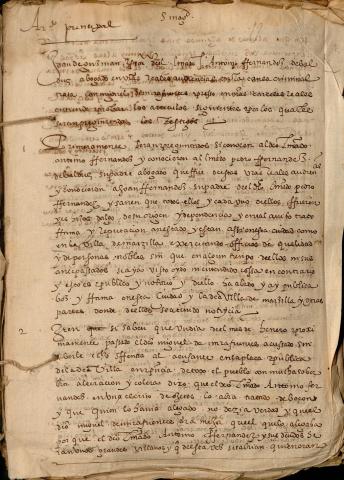
A month ago I found and requested the IGI record for the marriage of Juan de Padilla Sorro to Petrona de Siordia (misspelled Giordia in the IGI record), hoping to find additional information on this couple. The marriage took place in El Sagrario, Aguascalientes on 14 February 1616 (Batch M604761 Source Call 0299421). After an anxious wait today I received the reply that this record could not be found. I do not have access to that film at the local center to search it myself. Has anyone been able to locate this record? I would certainly appreciate a copy of the image or a transcript of the entire text.

Comentarios

Comentario

Jaime,

I don't have an image but here is the transcription:

"En 14 de febro. de 616 años desposse a Juan de Padilla ___ natural de Xerez
con Doña Petrona de siordia, Premissas las moniciones y demás diligencias
establecidas Testigos Alonso Perez, Nicolas Morillo, y Juan Gil estantes en
esta villa. - Velaronse a 13 de enero de 617 años fueron Padrinos Lope Ruiz
de Esparza y Doña María de Siordia cuñada del dicho Juan de Padilla i al
cassamiento fueron Padrinos Doña Juana de Siordia, y Martín Fernandez de
Vaulus su hermano el cual quiso despues descasar a su hermana por no tener
edad, Pero le valió poco la malicia. [firma] Lorezo Rodriguez."

I could not read the complete surname, but it should be Juan de Padilla y
Delgadillo.

Saludos,
Bill Figueroa

----- Original Message -----
From: "Jaime Alvarado"
To:
Sent: Thursday, August 28, 2008 9:11 PM
Subject: [Nuestros Ranchos] Petrona de Siordia and Juan de Padilla

A month ago I found and requested the IGI record for the

Comentario

Jaime,

The entry reads like this (except for the religious sacramental info common to most marriage entries). I have checked both my copy and that in Jose Luis Vazquez's book (p. 191).

En 14 de febrero de 616 (1616) anos desposse a Juan de Padilla (y Delgadillo), Natural de xeres con Dona Petrona de siordia premisas...(common sacramental info)...
siendo testigos Alonso Peres y Nicolas Morillo y Juan Gil, estantes en esta villa (de Aguascalientes). Velaronse a 13 de Enero de 617 (1617) anos, fueron padrinos Lope Ruis de esparsa y dona Maria de siordia cunada del dicho Juan de Padilla; y al cassamiento fueron Padrinos dona juana de sirodia y Martin fernandes de Vaulus su hermano, el qual quiso despues descasar a su hermana por no tener hedad, pero le valio poco la malicia.

By the way, I have already extracted this entire film, so if you need another look-up, perhaps I can help.Likewise, if you need an actual copy, let me know. Hope this is what you needed.

Connie Dominguez

--

Comentario

Jaime,

The entry reads like this (except for the religious sacramental info common to most marriage entries). I have checked both my copy and that in Jose Luis Vazquez's book (p. 191).

En 14 de febrero de 616 (1616) anos desposse a Juan de Padilla (y Delgadillo), Natural de xeres con Dona Petrona de siordia premisas...(common sacramental info)...
siendo testigos Alonso Peres y Nicolas Morillo y Juan Gil, estantes en esta villa (de Aguascalientes). Velaronse a 13 de Enero de 617 (1617) anos, fueron padrinos Lope Ruis de esparsa y dona Maria de siordia cunada del dicho Juan de Padilla; y al cassamiento fueron Padrinos dona juana de sirodia y Martin fernandes de Vaulus su hermano, el qual quiso despues descasar a su hermana por no tener hedad, pero le valio poco la malicia.

By the way, I have already extracted this entire film, so if you need another look-up, perhaps I can help.Likewise, if you need an actual copy, let me know. Hope this is what you needed.

Connie Dominguez

--

Question about Ana de Quesada (cc Miguel Hernández Rubio)

Hello, everyone!

I have a question concerning ancestor Ana de Quesada (born c. 1615, died before 22 November 1660), who married Miguel Hernández Rubio.

WikiTree suggests that her parents may have been Juan López de Lizalde and Ana de Quesada. Is there any evidence supporting this possible identification beyond her approximate date of birth and the fact that she is referred to as “Ana de Mendoza” in the marriage record of her daughter, María Rubio?

I'm trying to sort this out because we appear to have three ancestors named Ana de Quesada, all from Lagos and all living within approximately the same time period. It is becoming a bit confusing!

The three women are:

  • Ana de Quesada, married c. 1634 to Miguel Hernández Rubio
  • Ana de Quesada, whose first proven child was born in 1649 (Pedro b. 4 Nov 1649, padrinos: Pedro Gómez Portugal y Isabel Ortiz). This Ana de Quesada is possibly about ten years younger than the other two Anas or perhaps this was her second marriage; she married Gaspar Gómez de

Comentarios

Comentario

Just found this. 

4 Jan 1628: "died Diego Hurtado, son of Pedro Hurtado, vecino del Fresnillo, husband of Ana de Quesada, daughter of the elder Alonso de Quesada."

I'm assuming this refers to the Alonso de Quesada who married Juana Bautista Hernández de Arellano. 

I believe I found the most likely candidate for the wife of Miguel Hernández Rubio.

Thank you

Travis

Comentario

Postscript:

I'm especially interested to discover more about Ana de Quesada (cc Miguel Hernández Rubio). If she is indeed the daughter of Juan López de Lizalde and Ana de Quesada, then we will officially be descended from ALL the known daughters of Toribio Hernández de Arellano and Isabel de Mendoza. 

That would be amazing. 

Also, this may not mean anything but could be a clue to her identity, but I'm fairly certain the Ana de Quesada, who married Juan de Saavedra, was Española as their daughter, María de Saavedra , is referred to as Española in her baptismal record (1 October 1634). Ana de Quesada is referred to in that record as "Ana Alonso."

Thank you,

Travis

I need some clarity on Gómez Dispensas Confusion

Hello all!

I'm trying to untangle the relationship between three individuals: Joaquín Gómez, Gertrudis Gómez, and Antonio Gómez. WikiTree currently presents them as siblings—the children of an Unknown Gómez. The proposed relationships appear to be based primarily upon two dispensas from 1798 and 1780.

Gertrudis Gómez appears in both dispensas.

The first dispensa, dated November 1798, concerns the marriage of José Mariano Ysas and María Francisca Gómez. It gives the following relationships:

Gertrudis Gómez, hermana de Antonio Gómez
José Ysas, primo hermano de Gregorio Gómez
Andrés Ysas, primo segundo de Vicente Gómez
Pretenso José Mariano Ysas, primo tercero de María Francisca Gómez

The Gertrudis Gómez mentioned here is identified as the Gertrudis Gómez who married Ignacio de Isassi sometime before the 8 May 1710 baptism of their first documented child, Juan Antonio de Isassi.

Her purported brother, Antonio Gómez, is identified as Antonio Gómez, son of Gaspar Gómez and Magdalena de Gutiérrez AKA

New member

Hola a todos, me llamo Miguel y soy originario de Aguascalientes. Adjunto el árbol genealógico de mi tatarabuelo. Como verán, él tiene vínculos con varias familias de Los Altos, aunque desciende principalmente de las familias Hernández-Gamiño y Ascensio de León. Él nació en Pénjamo, al igual que sus padres, pero sus cuatro abuelos eran de la zona de Arandas-Ayotlán. Irónicamente, aunque yo soy de Aguascalientes, esta rama de mi árbol genealógico llegó a través de la ruta Arandas-Pénjamo-Angamacutiro (donde nació mi papá).

Hello everyone, my name is Miguel and I am originally from Aguascalientes. I am attaching my great-great-grandfather's family tree. As you will see, he has ties to several families from Los Altos, although he descends primarily from the Hernández-Gamiño and Ascensio de León families. He was born in Pénjamo, as were his parents, but all four of his grandparents were from the Arandas-Ayotlán area. Ironically, even though I am from Aguascalientes, this branch of my family

upload

Comentarios

Comentario

Hello Miguel,

Welcome to Nuestros Ranchos! I don't see any overlap between our family trees, but I'm sure there are others here who may share some of your ancestry.

I hope you find the answers you're looking for and enjoy being part of the group.

Thank you,

Travis

FLÓREZ-OSORIO / ERIK ANDRÉS REYNIOSO Y RENTERIA

Estimado Erik,

Hace algunos años publicaste un post sobre Hernán Flores y su ascendencia (o posible ascendencia). En alguna parte de tu publicación mencionas al linaje Flórez-Osorio y a los vizcondes de Quintanilla de Flórez.

En la primera mitad del siglo XVII vivió en celaya Diego Flórez de Robles Osorio, nacido en Valdepeñas alrededor de 1600, hijo de Francisco Flórez-Osorio y de doña Francisca de Cuéllar. No he podido encontrar información más allá de su lugar de nacimiento (bastante retirado de Quintanilla de Flórez) y los nombres de sus padres. He querido suponer que está relacionado con los ancestros del primer vizconde, pero no lo he podido probar. Parece ser que el primer señor de Quintanilla de Flórez fue el primero en apellidarse Flórez-Osorio, como hijo de Francisco Flórez García de Ríjoles y de doña Ana Osorio, señora de Cobrana Dentro de tus investigaciones ¿te has topado con algunos Flórez-Osorio que pudiesen haber marchado a Valdepeñas?

Diego es ancestro de muchas personas

Comentarios

Comentario

Estimado Erik,

Estaba preparando una respuesta y, por algún error que comúnmente cometo, he perdido el enlace a NR. Así que comienzo otra vez:

Interesante lo que mencionas de Felipe de Huete. Yo solo lo trato de pasada, pues estuvo casado con una señora miembro de una de las familias de fundadores de Celaya. Vengo preparando, desde hace muchods años, un libro sobre los fundadores formales de Celaya pero, cada vez que me pongo a la tarea de revisarlo antes de registrarlo y publicarlo, encuentro hilos de información de los que tiro y tiro y no me permiten acabarlo.

Por otra parte, tu faceta de investigador me interesa. Yo no he podido remontar mi línea de varonía (Félix de Arellano) más allá de Nicolás Félix, quien debió nacer alrededor de 1620 y vivió en Pánuco (Zacatecas), casado con Francisca de Peralta´(a quien un error que yo, involuntariamente, atyudé a propagar, llaman en las genealogías en línea como "doña" -nunca fue doña- Francisca de Peralta y Arellano -información que me pasaron

Comentario

Estimado Héctor,

Es muy interesante. A quien buscaba era a Juan Maldonado de Cuéllar, esposo de Sancha de Reynoso y Padilla Dávila. En su testamento, otorgado ante Hernando Enríquez del Castillo, consigna que era natural y originario de la villa de Valdepeñas, marquesado de Santa Cruz, Arzobispado de Toledo, reynos de Castilla, hijo legítimo de Diego Maldonado de Cuéllar y Juana de Ureña su legítima mujer. También de interés es que estuvo casado en segundas nupcias con Gabriela Fernández de Sepúlveda (hija de Gonzalo Fernández de Sepúlveda y Luisa Beltrán, también conocida por el apellido Sánchez) y que un primo suyo fue Gerónimo de Merlo. 

Por cierto, un cliente me contrató el año pasado para conocer la ascendencia del Felipe de Huete que indicas, remontándolo hasta 1350 de acuerdo con las probanzas de hidalguía de esa familia. Caso muy interesante.

Un cordial saludo,

Erik

Comentario

Estimado Héctor,

Disculpa la respuesta tardía. Voy a mirar si hay algo sobre los de Valdepeñas, los Flores/Flórez de Salamanca reclamaban parentesco con los marqueses de Astorga en sus pleitos de hidalguía y el marqués, que por las fechas debió haber sido Alvar Pérez Osorio, los trataba como primos. Esa fórmula Flórez + Osorio fue característica de esa rama cuyo solar estaba en las montañas de León. 

Por cierto hace unos años me zambullí en Valdepeñas buscando a unos Cuéllar/Maldonado pero no retomé el hilo. Volveré al tema y te comento.

Saludos cordiales,

Erik


Comentario

Estimado Erik,

De Valdepeñas era Roque Alonso Maldonado, vecino de Celaya:

Doña Isabel de Herrera, o Gutiérrez. Debió nacer en Celaya hacia finales del siglo XVI. Fue mujer en primeras nupcias de Roque Alonso Maldonado, regidor de Celaya, natural de la villa de Valdepeñas, en la región de La Mancha, reinos de Castilla, quien ya era viudo de Antonia de Torquemada.

En 1614 se le expidió a Roque confirmación del oficio de regidor de Celaya (1). Fue también procurador de la villa y, en 1632, Roque solicitó al virrey, a través del bachiller Rafael de Estrada, la confirmación de la merced de dos y media caballerías de tierra que el cabildo, justicia y regimiento de Celaya le había en el año de 1622 por su residencia en ella, vecinas de tierras de Antonio Tello, Alonso de Almansa y Alejos de Losa (2).

  1. ^  5 de noviembre de 1614. Expediente de Confirmación del oficio de regidor de Zelaya a Roque Alonso. AGI, México, 180, No. 34.
  2. ^  AGN, Tierras, Vol. 2705, Exp. 3

De Valdepeñas fue, también, Felipe de

Beyond Internet Trees: Introducing Genuspedia.com and EK Geneascore™

Dear Community Members,

Anyone who has researched family history on platforms like FamilySearch, Ancestry, MyHeritage, or Geni understands the double-edged sword: while they provide access to digitized records, they have also spread widespread and massive errors, mislinked namesakes, and unverified user trees. Accepting automated "hints" without consulting primary records has led many to build ancestral lines on shaky ground, to say the least.

To provide a refined, reliable alternative grounded in authentic archival sources, I have established two key resources through Genuspedia.com:

1. Genuspedia.com: Exclusive Primary Source Archives

For years, I have dedicated myself to transcribing, indexing, and analyzing original 16th to 18th-century manuscripts, including notary protocols, nobility proofs, inquisitorial files, and prenuptial investigations, from the historical repositories of Spain, New Galicia, New Spain, Guatemala, the Viceroyalty of Perú, USA, Portugal and the Bishopric of

Comentarios

Comentario

For those tracking our repository expansions, I also published the first official ingestion log:

Archival Ingestion Log I: Noble Lawsuits, Peerage Disputes & Notarial Protocols

This release incorporates cataloged abstracts covering noble lawsuits, peerage disputes, proof of lineage files, and notary protocols, essential resources for breaking through complex ancestral brick walls.

Additionally, Genuspedia now leverages specialized AI engines engineered to:

  • Cross-Check References Automatically: Interlink names, godparents, executors, and testamentary dispositions across thousands of scattered notarized and judicial records.
  • Automated Tree Building & Lineage Analysis: Map and analyze family trees grounded strictly in validated primary source evidence, eliminating false assumptions.
  • Deep Relational Analysis: Uncover hidden social networks, dowries, and kinship bonds embedded within old manuscripts that would otherwise take years of manual cross-referencing.

You can read the full breakdown of

Comentario

To keep the community updated on the continuous development of the platform, I have just deployed version 1.2 of EK Geneascore™ featuring the following enhancements:

  • 3-Generation Reliability Heatmap (7 Full Nodes): Expanded visual canvas covering the Target Ancestor, Parents, and Grandparents (paternal and maternal), allowing researchers to audit overall multi-generational lineage integrity in a single view.
  • Multi-Generational Audit Dossier (PDF Export): The reporting engine now compiles and exports an itemized, continuous audit report detailing all 7 ancestors in a unified PDF file ready for presentation or archival insertion.
  • Institutional Weights & Custom Settings: Full flexibility to customize base scoring values for each documentary category (notary protocols, nobility proofs, inquisitorial files, etc.), tailoring the audit engine to specific 16th to 19th-century archival contexts.
  • Refined "Baptism / Birth" Pillar: Standardized terminology across the interface and diagnostic output to

Are Sebastián Pérez (m. Isabel de Ávalos) & Sebastián Pérez (m. Leanor Ruvalcaba) the same person?

I’d really appreciate serious researchers’ thoughts on this Sebastián Pérez question.

Having reviewed the reconstructed family trees, baptism and marriage dates, and the various dispensas, it has become increasingly apparent to me that Sebastián Pérez, husband of Isabel de Ávalos, and Sebastián Pérez, husband of Leanor Ruvalcaba, were likely the same individual.

A father-and-son relationship has been proposed for these two men, but the chronology makes that relationship difficult to accept. Based on the estimated birth dates of Sebastián Pérez's sisters, Ana Pérez and María Burgueño, both of whom appear to have been born before 1600 (having children born as early as 1615), the Sebastián Pérez who married Isabel de Ávalos would have been too young to have been the father of all three siblings if the two Sebastiáns were separate generations.

A more plausible explanation is that there was only one Sebastián Pérez. He first married Isabel de Ávalos and, following her death, subsequently

Comentarios

Comentario

I have long held the belief that Sebastián Pérez (born ~1600) married to Isabel de Ávalos and Sebastián Pérez married to Leonor González de Ruvalcaba are the same person. We know from various dispensas that the latter Sebastián's sisters were María Burgueño (b. ~1590) and Ana Pérez (b. ~1595) which would support the assumption that Sebastián married twice. Unfortunately, as you said, a supporting document has not yet been found to prove that they are the same person. Similarly, it seems reasonable that the parents of María Burgueño, Ana Pérez and Sebastián are Diego Pérez and Beatriz Burgueño, however, supporting documents have not yet been found to prove this.

Un cordial saludo,

Austin Pérez

Comentario

Hello Austin,

I'm relatively new to Colonial genealogy and still make mistakes, so I appreciate your thoughts on this subject, and I agree with your take. 

In my own tree, I've merged the two Sebastians, with a note explaining that, while the circumstantial evidence for identifying them as the same person is quite strong, the identification has not been definitively proven.

I have particular interest in this family. We are descended from Juana Burgeño (married to Hernando Medel), Ana Pérez (married to Bartolomé Martín), and, of course, Sebastian Pérez. We also have other Pérez ancestors from Lagos during the same period (1620-1670), some of whom may be connected to the family of Diego Pérez.


Comentario

Hello Austin, 

The craziest thing happened today...

I was scrolling through 1670s marriage records on FamilySearch when I stumbled upon the marriage record of my 7th great-grandmother. That discovery led to the identity of her parents—and then her grandparents: the infamous philanderer Sebastián Pérez and his wife, Josefa de Casteñeda!

It’s truly a small world (in the 1600s at least).

Thank you,

Travis


Comentario

Nice!

I too recently located additional information on Sebastián's second marriage to María Garcia, daughter of José García Rodríguez and Margarita Gutiérrez del Castillo.


Donaciano Diaz de Leon

Greetings to all.

Trying to fully understand and find what Diaz de Leon branch I come from.

Comentarios

Comentario

Hello, 

I have been researching the Díaz de León roots for more than a decade. The only information we currently have about Juan Díaz de León and Inés Domínguez de Garfiascomes from the two wills of their son Juan, both of which were indeed located thanks to Manny. The surname González does not appear in either document, so I am unsure where this information originates. My advice would be to ignore it. 

I do have a few leads that could potentially extend the lineage further back, but so far I have not found any documentary evidence to support them.

Last winter, I visited Ayamonte and tried to access the local archives but unfortunately I did not have enough time. It is a charming small town on the Guadiana River with two beautiful churches in which one of them Juan may have been baptised in the last decades of the 16th century. If you are interested in the history of Ayamonte, the city hosts an annual Jornada de Historia, during which several historians present their research on the

Comentario

Congratulations Alex on finding the correct lineage.   I also have Diaz de Leon in my ancestral lines. I descend from one of Andres Diaz de Leon’s brothers. I heavily studied your branch before Manny Diez Hermosillo informed me that I descend from his brother. Manny’s research into this line has been very rewarding. 

Good luck in your continuing research,

Rick A. Ricci

Comentario

After several years of searching, I was finally able to confirm my ancestry using marriage documents, death certificates, child christenings, and every record I could get my hands on. It has been a long journey, but being able to connect the generations and verify the Díaz de León my lineage has been incredibly rewarding.

Juan Díaz de León - b.1550
don Juan Díaz de León Domínguez-Grafias - b.1580
Juan Díaz-deLeón Ortega "el Mozo" - b.1621
Jacinto Díaz de León - b.1655
Andrés Díaz de León y Gil - b.1686
Andres Díaz de León y Durón - b.1728
Joseph Aquilino Diaz de Leon Carillo - b. 1748
Jose Hilario Diaz de Leon López - b. 1784
Jose de la Rosa Díaz de León Delgadillo - b. 1820
Agustin Díaz de León Leos - b. 1843
Rodrigo Diaz de Leon - b. 1869
Donaciano Diaz de Leon - b. 1894
Ismael Diaz de Leon - b. 1926
Refugio Alejandro Diaz de Leon  Sr - b. 1950
Alejandro Diaz de Leon Jr - b. 1971


Comentario

The Díaz de León Family History 

Compiled by

Alejandro Díaz de León Mejía

A family is not measured solely by the years it has existed, but by the character, faith and perseverance it passes from one generation to the next.

For several years I searched not simply for names and dates, but for the stories behind them. Who were these people? Where did they live? What hardships did they endure? Why did they leave Spain? How did they help build communities in New Spain (Mexico)? What legacy did they leave for future generations?

The answers were not found in a single document or family tree. They emerged gradually through historical records, church registers, land records, wills, family documents, oral history, and the patient work of comparing one source against another.

This family history record represents the beginning not the conclusion of that journey. 

Its purpose is to preserve what I have learned and share it with our family. Genealogical research is constantly evolving as new records

Ruiz Esparza names and titles in the 1500s

When I cleaned up several generations on the Esparaza tree on Family Search to reflect the accurate relationships I was very careful to include the correct mother’s maiden name on each record which was especially important on generations with the same name, like Lope Ruiz Esparza Espinosa and Lope Ruíz de Esparza Diaz. However, the same Family Search user who had deleted the couple relationship mentioned on my previous post changed a number of the names, including some, but not all of the wives by adding long extensions like these: 

Lic. Lope Ruíz De Esparza Espinoza Sr. De Esparza de Galar y Zariquiegui 
Lic. Pedro Ruíz De Esparza Caparroso Sr. De Esparza de Galar y Zariquiegui - Lope Ruiz Esparza Espinosa’s son Martin Ruíz De Esparza Huici Sr. De Esparza de Galar y Zariquiegui - Lope Ruiz Esparza Espinosa’s father 
María de Larrasoaña Sra. Del Palacio de Zariquiegui – One of Martin Ruíz De Esparza Huici’s wives (Not Lope’s mother)

This extended version of the name was obviously taken

Comentarios

Comentario

Hello Travis,

I took another look at Bartolome de Mesquita.  His wife Lucia Torres doesn’t show any Silva ancestry.  In looking for Bartolome de Mesquita’s ancestry. I would first search his name with a mother surnamed Silva.   Next I would replace the Mesquita with Silva and look for a Bartolome Silva.   Mesquita may be a location from where he was from and took it as a surname replacing Silva.  Amesquita is a variation of Mesquita so also search with that spelling.  

Good luck in your research,

Rick A. Ricci

Comentario

Hello Rick,

Thank you for the info and tips. I'll implement them during my searches.

I agree that the Silba/Silva is probably on Bartolomé's side. I charted 2 possible families to which he may belong. One of these families is documented with Converso affiliations. 

Our Gómez line features 5% Sephardic DNA according to ancestry (tested by a very close relative) and Bartolomé Mesquita and Luisa de Torres are ancestors about 7 times over (our family is descended from them through multiple children, sometimes multiple times). So I've been concentrating on the aforementioned converso Mesquita/Amesquita group.

I hope progress can be made as this couple represents such a large part of our family history. 

Thanks again. 

Best,

Travis

Comentario

I found the post that I wrote that I referenced but it focused on surnames changes according to location. Here it is:


“Published by R.A.Ricci (not verified) - Mon, 2016-05-30 20:47 | Permalink

Change in surnames according to location given

Comment

Someone asked me to explain the change in surnames in the Ochoa-Garibay pedigree.

If someone here in West Los Angeles asked where I live I would say Mar Vista. If I was in Northern California I would answer Los Angeles. if I was in another state, let's say a state clear across the country on the eastern coast, I would answer California. If I was in another country, I would answer the United States of America. This is how the surname sometimes changed from one generation to the next for Spaniards in the 15th and 16th centuries. The surnames didn't always change permanently. This was a naming pattern in these basque provinces. Some families kept their same surname even if they moved around. Some other families changed their surname often. In some

Comentario

Hello Rick,

Thank you for posting this comment. Your modern parallel using Mar Vista, LA and CA is excellent. It helped.

Yes, 17th century Colonial surnames are challenging for a novice like myself but much more preferable - from a genealogical perspective - over Anglo naming practices, where these valuable clues are lost after marriage! 

Connected story: using the 1669 Padron of Santa María de los Lagos, I charted out the family of Juan Días Toribio and Inés de Abrego. Most of their children assumed the surname Días, but some daughters opted to occasionally use "Abrego." 

For almost a year I assumed that the "Antonia Rodrígues," who lived on the same Hacienda was a worker or servant. She is listed among the servants further down the list from the family. Later, I discovered her serving as madrina in multiple baptisms alongside her father "Juan Días Toribio" as padrino. 

I learned a lesson. Never make assumptions based upon surnames in Colonial records.

This brings me to a surname question:

W

Comentario

Hello Travis,

Toribio, as many other names in Spanish, may be a personal name or a surname. By coincidence, I recently had a medical proceeding and the doctor's name happens to be Héctor (like myself) Toribio. My own first surname is Félix, and I have Carlos and Felipe, among others, as surnames in my family tree. Common surnames are Jaime, Lorenzo, Santiago, Miguel, Juan, etc. In Spain, at the introduction of the Civil Registration (ca 1860), most people with this kind of surname were added the preposition "de" to make clear that it was a surname.

Best regards,

H

Comentario

Hello Hector!

I have not been able to identify the parents of either Juan or Inés.

Here is what I know so far:

Juan Díaz Toribio and Inés de Abrego appear to have moved from Teocaltiche to Lagos sometime between the baptisms of their daughters Inés de Abrego, on 8 June 1641 in Teocaltiche, and Micaela Díaz, on 16 October 1643 in Lagos.

According to 1748 property records, Juan Díaz Toribio purchased the Estancia de Buenavista from Pedro Arias Pardo. There is no date given for the purchase, but I suspect it may have occurred sometime around 1641–1643, coinciding with their move from Teocaltiche to Lagos. After Juan Díaz Toribio's death (abt. 17 Aug 1669), his hacienda, the Estancia de Buenavista, was divided among his four youngest children: Nicolás, Elvira, Tomás, and Ana. Unfortunately, I cannot understand all the information in the record and AI isn't much help, so I am not sure how the property passed out of their hands.

I have tried to determine the location of the Estancia de Buenavista

Comentario

The 1748 property record: https://www.familysearch.org/ark:/61903/3:1:3Q9M-CSD2-RVG3

Baptism of Inés de Abrego, on 8 June 1641 in Teocaltiche: https://www.familysearch.org/ark:/61903/3:1:9392-GRS3-C1

Baptism of Micaela Díaz, on 16 October 1643 in Lagos: https://www.familysearch.org/ark:/61903/3:1:9392-G5R2-L


Comentario

Hello Travis,

The information you have found is quite interesting. It tells where they came from and the time frame. I will and try to find the Teocaltiche padrón you have mentioned and keep looking. Toribio is a rather uncommon surname and Ábrego isn't either very common, although we know that the transmision of surnames didn't follow any logic at the time and it was rather capricious.

Best regards,

Héctor

Comentario

Hello Hector, 

Since our last exchange here, I looked back over my notes for Juan Díaz Toribio and noticed the padrinos for the 26 Feb 1656 baptism of his son Tomás are Nicolás Díaz and his wife Ana Nuñez.

What I've found so far on Nicolás Díaz:

Nicolás Díaz cc Ana Nuñez, children:

  1. Baptism 9 Aug 1646 Nicolás Díaz
  2. Baptism Sep 1648 Agustín Díaz

The dates of their sons' baptisms indicate Nicolás Díaz and Ana Nuñez are in the same age set as Juan Díaz Toribio and Inés de Abrego. 

Maybe Juan and Nicolás are brothers? Cousins? 

It's a clue for a potential new avenue of research on the family's origins.

Thank you, 

Travis

Comentario

Hi Dana, 

I'm going through a similar dilemma and settled on a similar solution. Thanks for your perspective. 

Everything is standardized today compared to the past so it's taken me a long time to get my mind around this. Even relatives who recently lived in Mexico don't understand naming customs from the colonial period.

Here's a question - not just for you - but for anyone who can answer: what about those with two completely different names?

Example: Ignacío (b c1630) son of Bartolomé de Mesquita and Luisa de Torres, was obviously named after someone, probably a relative, named Ignacío de Silva. So we have some records naming him Ignacío de Silva and others referring to him as Ignacío de Mesquita.

Thank you, 

Travis

Comentario

Ignacio was probably named after a grandparent or greatgrandparent that was surnamed Silva. I have even seen a surname skip even more generations.   I few years ago I wrote about surnames in a post about the Ochoa Garbay family surnames.   I will look for it and add it here.

Rick A. Ricci

The Essential Bookshelf for Nueva Galicia and Viceregal Research: Canonical Works & Community Recommendations

Dear Friends and Colleagues,

Following the recent synthesis on researchers who have shaped colonial lineage historiography (A Compendium of Essential Genealogists and Historical Researchers of New Spain), and based on the interesting comments of our colleague Héctor Félix Aizcorbe, it is time we turn our attention to the physical and digital toolkit: the canonical reference works, published genealogical collections, and regional monographs that serve as our daily analytical baseline.

Whether investigating 16th-century lineages or 17th-century notary protocols, certain works remain indispensable.

I invite all members to reply with their most relied-upon books, using the suggested layout below.

For example:

1)Retoños de España en la Nueva Galicia (10 Volumes) Author: Dr. Mariano González-Leal, Knight of the Royal Brotherhood of Infanzones de Illescas, Knight of the Noble Chapter of the Order of our Lady of Mercy (Orden de la Merced), Hidalgo de España, and a long etc. Scope & Significance: An

Comentarios

Comentario

Erik, 

A small, but very good publication.

1)Cofradia de las Benditas Animas del Purgatorio de Jalostotitlan: Instituida en 1627(167 Pages) Author: Sergio Gutierrez, a engineer by profession and an enthusiast of the history and genealogy of the Los Altos region of Jalisco, Mexico. For over a decade, he has been studying and analyzing ancient manuscripts related to these fields of research. This short publication includes the paleography of the manuscripts, as well as the records of the proceedings for founding the confraternity, the elections of stewards, the official records of visits by the ecclesiastical authorities of the Bishopric of Guadalajara, the accounting records, and the membership lists. To support the main text, the genealogical trees of the principal founding families are appended, along with a representative selection of photographs of the manuscripts, and finally, a table summarizing the administrators who led the confraternity during its first century of existence. It

INTRODUCTION TO THE VAZQUEZ DEL MERCADO FAMILY

Hello everyone,

I don't remember having seen before a post by ramon sanchez, made onTue, 2022-09-27, and a comment by Alex Mercado re the Vazquez del Mercado family, so I want to give a partial answer to their concerns.

For what I have studied, there are at least two branches of Vázquez de Mercado: One descending from Ginés, nephew of Bernardino Vázquez de Tapia, and  another one descending from doña Ana Vázquez de Mercado y Tapia (daughter of Pedro (II) Carrillo de Ávila and doña Sancha de Belmar -who, mistakenly, many people make a daughter of Bernardino Vázquez de Tapia, the conqueror), herself a great-granddaughter of Bernardino Vázquez de Tapia, married to Mateo de Río de Losa, many of whose descendants, male and female, bore the surname Vázquez de Mercado or, simply, Mercado. I know for sure some of doña Ana's descendants, and I have the feeling that some of the Vázquez de Mercado from Fresnillo are descendants of doña Ana, but I haven't been able to establish the exact connection

Pérez de Ornelas

Decided to start a new thread on this: 

in an earlier post, Daniel Méndez Camino said: 

"Sebastián Pérez de Ornelas, my tenth great-grandfather, married Leonor González de Ruvalcaba, daughter of Juan González de Ruvalcaba and Leonor Franco de Paredes. I don't know if this Ornelas is related to the same family that settled in Los Altos, but I've only seen a few people with the surname Pérez de Ornelas; I don't know its origin."

My ancestor, Juan Pérez, AKA Juan de Santoyo, born about (or before) 1624 (probably in Lagos), had a probable relative named Gerónima de Ornelas. 

Listed in Juan's household in the 1669 Padron de Santa María de los Lagos is Gerónima de Ornelas, Viuda, living with Juan's widow, Antonia de Villegas, AKA Antonia de Mendoza, and their children (all of Juan and Antonia's known and suspected children assumed surnames of Santoyo, Pérez, Villegas and/or Mendoza).

I have no idea how Gerónima de Ornelas is related to Juan Pérez (AKA Juan de Santoyo). Sister? Mother? Daughter

Comentarios

Comentario

Hello Hector,

I'm so appreciative of your reply and of the information you've shared.

We are descended from Juan Pérez de Santoyo and his wife, Antonia de Villegas, AKA Mendoza, through multiple lines.

In my research, I had come across the Pérez de Santoyo family of Salamanca and wondered whether there might be a connection between that family and our Juan Pérez de Santoyo. Given the information you've now provided, it seems increasingly likely that there may indeed be a connection.

I have to admit that I'm saddened that the trail appears to have gone cold and that we may never discover more about Juan. He represents such a significant part of our ancestry, and it would be wonderful to know more about where he came from and how he came to be in Lagos.

Would you possibly be able to point me toward any resources that might help me learn more about the Pérez de Santoyo family of Salamanca?

Thank you again for taking the time to share what you've found. I truly appreciate it.

Travis


Comentario

Hola Travis,

Los Pérez de Santoyo (Pérez de Hoyos, Pérez Quintana, Pérez Quintana de Hoyos, etc.) son una familia española que se estableció en Salmanca (Guanajuato) en su fundación (1602) en la figura de Juan Pérez Quintana, de quien tu Juan podría ser hijo o nieto. Fue una familia muy prolífica y destacada en la region de El Bajío. Muy probablemente tu Juan haya nacido en Salamanca. Lamentablemente, los registros de bautismos de esa villa empiezan en 1651 y los matrimonios en 1689 (Juan debió nacer alrededor de 1620) y no hay registros parroquiales de esos fechas en los principales lugares de la región en donde estuvieron los Pérez de Santoyo (Celaya, Salamanca, Salvatierra, Valle de Santiago). Como cosa curiosa, el cura José María Morelos y Pavón era, por varonía, un Pérez de Santoyo.

Juan y Antonia de Mendoza casaron en Santa María de los Lagos el 3 de agosto de 1643 ( Santa María de los Lagos. Bautismos 1634–1665).

El primer Ornelas en Salamanca aparece en 1685 en la figura de María

Comentario

Hello Hector,

I'm so appreciative of your reply and of the information you've shared.

We are descended from Juan Pérez de Santoyo and his wife, Antonia de Villegas, AKA Mendoza, through multiple lines.

In my research, I had come across the Pérez de Santoyo family of Salamanca and wondered whether there might be a connection between that family and our Juan Pérez de Santoyo. Given the information you've now provided, it seems increasingly likely that there may indeed be a connection.

I have to admit that I'm saddened that the trail appears to have gone cold and that we may never discover more about Juan. He represents such a significant part of our ancestry, and it would be wonderful to know more about where he came from and how he came to be in Lagos.

Would you possibly be able to point me toward any resources that might help me learn more about the Pérez de Santoyo family of Salamanca?

Thank you again for taking the time to share what you've found. I truly appreciate it.

Travis


A Compendium of Essential Genealogists and Historical Researchers of New Spain

The study of genealogy within the historical framework of New Spain and modern Mexico represents a critical, specialized branch of Latin American historiography. Far from being a mere collection of ancestral lists, colonial Mexican genealogy serves as an essential lens through which scholars examine social stratification, economic structures, land distribution, and the transmission of political power from the early viceregal era through the nineteenth century. The research produced in this domain relies heavily on rigorous archival paleography, the critical analysis of notary protocols (protocolos notariales), ecclesiastical records, and inquisitorial proceedings, bridging family history with broader socio-economic and demographic realities.

To synthesize a truly comprehensive overview of this field, this compendium integrates a cross-model AI consensus, drawing upon comparative evaluations from Gemini, Claude, and ChatGPT to evaluate figures based on archival discoveries, published

Comentarios

Comentario

Dear Erik,

Thank you for publishing such an extraordinary and comprehensive synthesis of the giants in our field. As a fellow researcher mapping the human terrain of Nueva Galicia, reading your master summary was deeply inspiring. I completely agree with your closing sentiment: we are indeed links in a continuous chain, standing on the shoulders of the master archivists and paleographers you so beautifully chronicled.

To answer your closing question—my journey was largely inspired by the profound oral histories passed down by my grandfather, Joe Segoviano Muñoz, who migrated from San Julián, Jalisco, to California in 1923, narrowly escaping the Cristero War. My desire to verify his stories led me to the works of Dr. Mariano González-Leal (whose Retoños volumes sit in my home office) and propelled me into the incredibly complex, interwoven genearca lineages of Los Altos.

In my professional life, I am a former Special Operations Civil Affairs Soldier, and I currently serve as an Integration

Comentario

Buenas tardes (en Madrid), Erik,

Veo con agrado que has incluido a don Fernando Muñoz Altea en la relación que has propuesto en este forum (y quizás en algunos otros) de estudiosos y autores genealogistas del virreinato de la Nueva España. 

Fernando, añorado gran amigo, trabajó incansablemente hasta la avanzada edad de 93 años en la genealogía y en la heráldica, ciencia auxiliar de la historia de la que en México existen muy pocos estudiosos. Fue Rey de Armas de la Casa de Borbón-Dos Sicilias y una colaborador clave para la rehabilitación/recuperación del título de Conde de Gustarredondo (llevada a cabo por el también entrañable Guillermo Tovar quien, por el caballeroso gesto que tuvo con quien ese momento ostentaba irregularmente el título y por su inesperada muerte, se vió impidido de  ostentarlo. Ahora lo ostenta su sobrino) y la sucesión del título de Conde Santa María de Guadalupe del Peñasco, coautor de las monografías relativas a ambos títulos y autor de muchas obras más. Tengo a

Comentario

Estimado Héctor,

Gracias por expandir y enriquecer la lista de manera tan importante; lo de Ricardo Ortega y Pérez-Gallardo era una omisión imperdonable. Todos ellos han contribuido de manera sustancial a la investigación genealógica y, por ello, veo en este hilo una excelente oportunidad para hacer una petición pública.

El Seminario de Genealogía Mexicana del Dr. Sánchiz es consultado ampliamente y, como sabemos, constituye un valioso esfuerzo compilatorio en el cual se ha vaciado el contenido de diversas obras de investigación, como la de Mariano (Retoños de España en Nueva Galicia). Sin embargo, al tratarse de una compilación fundamentada en su mayoría en obras secundarias y no en repositorios documentales originales, existen incontables inconsistencias que terminan replicándose en otras plataformas, perpetuando el error.

En el caso de los Reynoso, llevo años consignando la genealogía correcta basada en fuentes primarias (y que constituye mi expediente de ingreso al Capítulo Noble de

Comentario

Estimado Erik,

No puedo estar menos que de acuerdo contigo en lo que se refiere al Seminario de Genealogía Mexicana. Es tanta la información errónea que su corrección me parece una tarea casi imposible. La idea del Seminario es magnífica, desafortunadamente, creo que cualquiera puede entrar, insertar infortmación -con o sin respaldo documental- y originar o perpetuar errores, y parece que el equipo que trabaja en ello carece de la capacidad o el tiempo para revisar todos y cada uno de los datos ingresados. Desde mi punto de vista, debería exigirse la comprobación documental o, por lo menos, la deducción razonable basada en triangulación de información documental (y la aclaración de que se trata de una deducción) antes de que la información sea hecha pública. Sería ideal enderezar la idea original del Seminario y eliminar errores o información sin fundamento.

Te envío un cordial saludo.

Héctor

Comentario
  • Gabriel Agraz García de Alba (1926–2009)

    Legacy: Prolific historian, biographer, genealogist, and long-time Director of the Biblioteca de la República in Mexico City. Author of landmark historical-genealogical works including Los García de Alba and extensive bio-bibliographical studies of Jalisco figures.

    Focus: Exhaustive primary-source extraction of Tecolotlán, Autlán, and central-western Jalisco lineages, bridging familial genealogies with broader regional bio-history and political iconography.

  • Dr. Tomas Hillerkuss

    Legacy: Historian and professor at the Universidad Autónoma de Zacatecas; author of the multi-volume Diccionario biográfico del Occidente novohispano del siglo XVI.

    Focus: Early 16th-century prosopography, notary protocols, and elite socio-economic networks of Nueva Galicia and Nueva Vizcaya (specifically Zacatecas, Guadalajara, and Compostela).

  • Jorge Barba Gómez
  • Legacy: Local historian and genealogist, author of key regional monographs on Alteño lineages, including Con el

Seeking Donativo List for Don Salvador Muñoz de la Barba (Jalostotitlán / La Ciénega, 1780)

Hello friends,

I hope everyone is doing well. I’m reaching out to the community because I’m working on a historical‑genealogical project that intersects both Los Altos de Jalisco research and American Revolutionary War lineage documentation.

Over the past year, I’ve been in active communication with both the DAR (Daughters of the American Revolution) and the SAR (Sons of the American Revolution) regarding my ancestor:

Don Salvador Manuel Muñoz de la Barba

(Vecino español of Jalostotitlán, Resident of Rancho La Ciénega, Comisario de la Acordada, Documented in 18th‑century parish and notarial records)

As many of you know, Spain supported the American Revolution through the Royal Donativo of 1780, ordered by King Carlos III, requiring heads of household, titled Spaniards, landowners, and Crown officials to contribute funds (typically dos pesos in rural Nueva Galicia).

Recently, the National SAR Lead Genealogist, Travis Franklin, reviewed my ancestor’s dossier. His official response clarified

Comentarios

Comentario

Estimado Francisco Javier,

Muchas gracias por tomarse el tiempo de responder a mi publicación sobre el Donativo de Don Salvador Muñoz de la Barba. Vi que apareció su nombre como respuesta, así que quise escribirle directamente.

Estoy investigando a profundidad la familia Muñoz de la Barba en Los Altos de Jalisco, especialmente el periodo de 1760–1800, y recientemente encontré un documento de 1781 donde aparece un Comisario de la Acordada llamado Don Salvador Barba, que podría corresponder a Salvador Manuel Muñoz de la Barba.

Me encantaría colaborar con usted si está interesado. Tengo:

el expediente eclesiástico de 1781,

notas sobre la familia en Jalostotitlán y La Ciénega,

análisis del libro Los Barba de Los Altos de Jalisco,

y otros documentos coloniales relacionados.

Con gusto comparto todo lo que tengo, y me encantaría saber si usted posee información adicional, documentos, o líneas familiares que puedan ayudar a confirmar esta conexión.

Quedo a sus órdenes y con mucho gusto seguimos la